Prácticas del caminar.
Abstract
En este escrito se abordarán prácticas artísticas que incorporan caminatas en sus procedimientos de entrenamiento y escenificación del cuerpo. Nos remitiremos al arte de caminar en las propuestas escénicas japonesas, iniciado por Zeami a fines del año 1300 y sus transformaciones y actualizaciones en las investigaciones de bailarines butoh a partir de la década del 60. Observaremos particularmente la “caminata natural” propuesta por el bailarín Katsura Kan en el seminario dictado en el CePIA (Centro de Producción e Investigación en Artes) de la Universidad Nacional de Córdoba (UNC) durante el mes de junio del año 2011, para luego trazar algunas conexiones con el trabajo iniciado por Fedora Aberastury en Buenos Aires (Sistema Conciente para la Técnica del Movimiento), que incluye el caminar como acción esencial de su práctica. Conceptualizaremos en torno al valor del silenciamiento, la observación y la construcción de una presencia del cuerpo basada en la transitoriedad.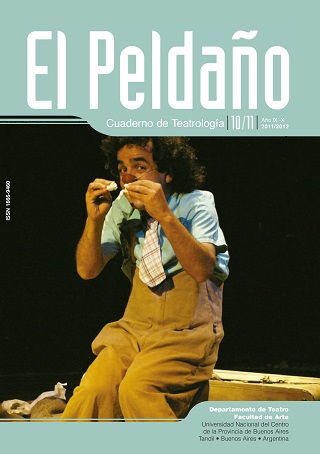
Downloads
Published
2011-12-01
How to Cite
Comandú, M. (2011). Prácticas del caminar. The Step. Notebook of Theatre Studies, (10-11). Retrieved from https://www.ojs.arte.unicen.edu.ar/index.php/elpeldano/article/view/205
Issue
Section
Artículos
License
As part of its self-archiving policy, the journal's editorial team retains the version of the article that has been corrected and published on the platform for preservation or subsequent use in institutional repositories, virtual archives, or other linked publication venues.

This journal is licensed under a Creative Commons Attribution-NonCommercial-ShareAlike 4.0 International License.

Creative Commons License

This means that the original author of the content holds the economic rights. By publishing under a Creative Commons BY-NC-SA license, authors retain ownership of their rights while granting the journal a license to publish their work under these conditions; they also allow third parties to share and adapt the work for non-commercial purposes, provided that authorship is attributed and derivative works are shared under the same license.

Understanding the CC BY-NC-SA License
BY (Attribution): Users must give credit to the author or original source.

NC (Non-Commercial): Users may not use the work or its derivatives for commercial purposes.

SA (ShareAlike): If users modify or adapt the work, they must distribute their contributions under the same CC BY-NC-SA license or a compatible one.