The real body in ficcion
Keywords:
body, performance, fiction, realAbstract
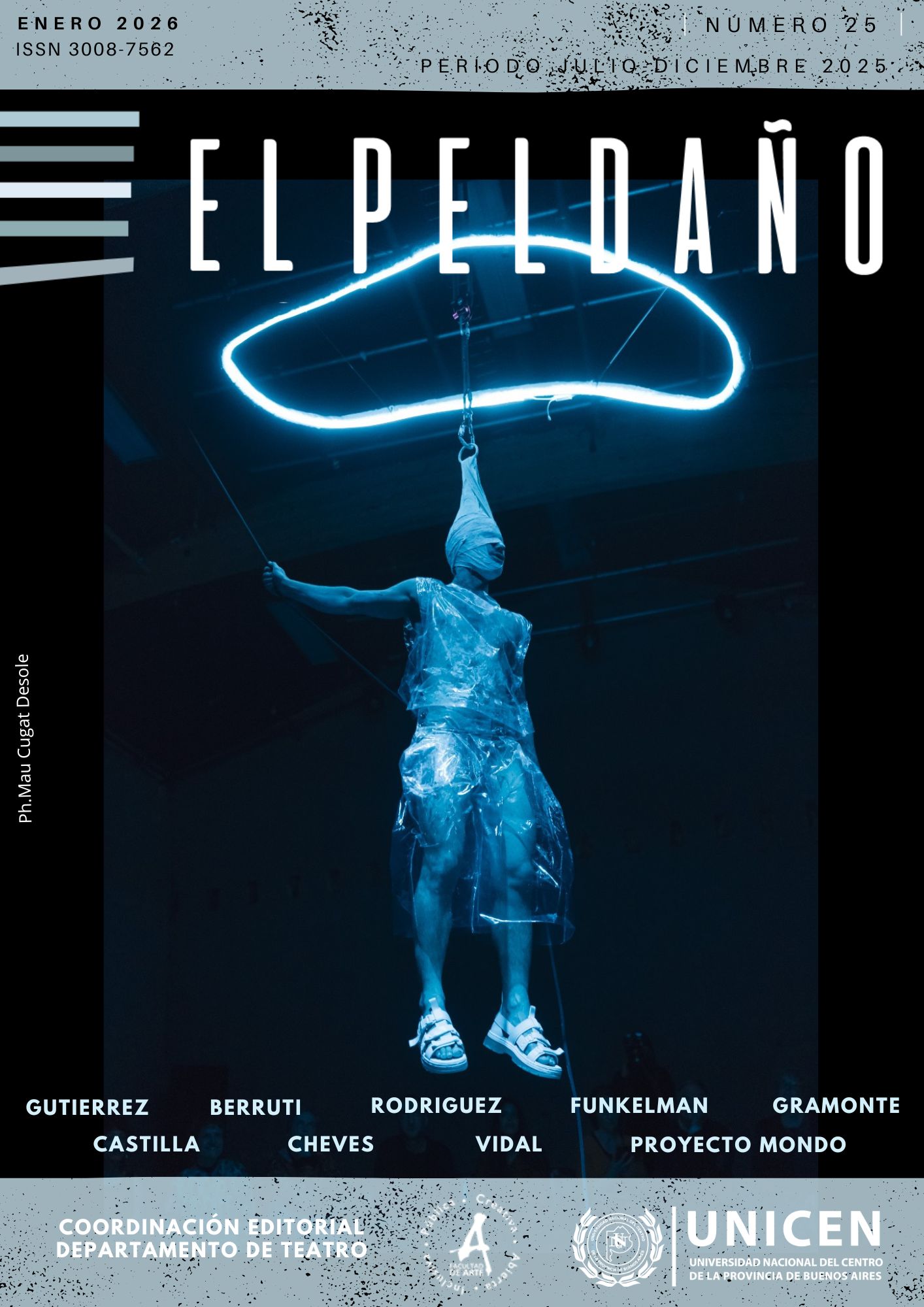
This paper examines the notion of the "real body" on stage, a concept discussed at the First International Art Congress of the National University of the Center. It raises a central question for the performing arts: what does it mean to speak of reality in a medium founded on artifice? The analysis focuses on the tension the body enacts between its concrete presence and the fiction it embodies. To address this, the paper distinguishes theater from performance, considering the dynamics of the spectator-participant in hybrid contexts where interaction, chance, and spontaneity play a key role. Finally, the "real body" is proposed as a symbolic construction, infused with collective and cultural meanings, which opens a space of dialogue between the fictional and the social.
References
Argentina. (2006). Ley 26.150: Educación sexual integral en todos los niveles del sistema educativo [Ley]. Boletín Oficial de la República Argentina. https://www.boletinoficial.gob.ar
Argentina. (2012). Ley 26.743: Reconocimiento de la identidad de género [Ley]. Boletín Oficial de la República Argentina. https://www.boletinoficial.gob.ar
Argentina. (2019). Ley 27.499: Capacitación obligatoria en género para personas en todos los niveles del Poder Ejecutivo Nacional [Ley]. Boletín Oficial de la República Argentina. https://www.boletinoficial.gob.ar
Argentina. (2020). Ley 27.610: Interrupción voluntaria del embarazo [Ley]. Boletín Oficial de la República Argentina. https://www.boletinoficial.gob.ar
Danan, J. (2016) Entre teatro y performance. Artes del sur.
Fischer-Lichte, E. (2004) Estetica de lo performativo. Abada editores.
Groys, B (2014) Volverse público: Las transformaciones del arte en el ágora contemporánea. Caja Negra.
Rancière, J. (2008). El espectador emancipado. Manantial.
Lehmann, H. (1999) Teatro posdramático. Cendeac.
Taylor, D. (2012) Performance. Asunto impreso ediciones.
Ure, A. (2003) Sacate la careta: Ensayos sobre teatro, política y cultura. Grupo editorial Norma.
Published
Versions
- 2026-07-20 (2)
- 2025-12-16 (1)
How to Cite
Issue
Section
License
Copyright (c) 2025 Matías Castilla

This work is licensed under a Creative Commons Attribution-NonCommercial-ShareAlike 4.0 International License.
As part of its self-archiving policy, the journal's editorial team retains the version of the article that has been corrected and published on the platform for preservation or subsequent use in institutional repositories, virtual archives, or other linked publication venues.

This journal is licensed under a Creative Commons Attribution-NonCommercial-ShareAlike 4.0 International License.

Creative Commons License

This means that the original author of the content holds the economic rights. By publishing under a Creative Commons BY-NC-SA license, authors retain ownership of their rights while granting the journal a license to publish their work under these conditions; they also allow third parties to share and adapt the work for non-commercial purposes, provided that authorship is attributed and derivative works are shared under the same license.

Understanding the CC BY-NC-SA License
BY (Attribution): Users must give credit to the author or original source.

NC (Non-Commercial): Users may not use the work or its derivatives for commercial purposes.

SA (ShareAlike): If users modify or adapt the work, they must distribute their contributions under the same CC BY-NC-SA license or a compatible one.